
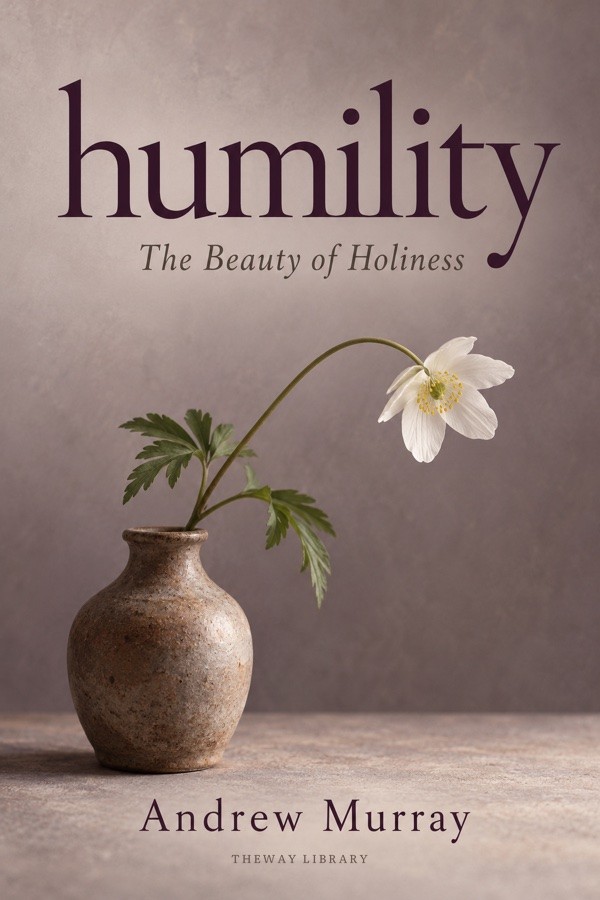
Humility: The Beauty of Holiness
A reflection on humility as the foundation of discipleship and the beauty of holiness.
Read free onlineAbout 2 hours to read · 14 sections
Original 1895 text; author died 1917. US and UK terms expired.
Contents
- Preface
- Chapter I: Humility: The Glory of the Creature
- Chapter II: Humility: The Secret of Redemption
- Chapter III: The Humility of Jesus
- Chapter IV: Humility in the Teaching of Jesus
- Chapter V: Humility in the Disciples of Jesus
- Chapter VI: Humility in Daily Life
- Chapter VII: Humility and Holiness
- Chapter VIII: Humility and Sin
- Chapter IX: Humility and Faith
- Chapter X: Humility and Death to Self
- Chapter XI: Humility and Happiness
- Chapter XII: Humility and Exaltation
- Notes
Every Scripture reference in this book (40)
Articles about Humility: The Beauty of Holiness
- Andrew Murray Books: A Guide to All 35 and Where to StartA reading guide to Andrew Murray's books in TheWay Library, grouped by subject: prayer, abiding in Christ, surrender, the Holy Spirit and more.
- Best Christian Books on Holiness: 15 Classics on Living HolyClassic Christian books on holiness and sanctification by Bonar, Murray, Owen, Ryle, Moule, Wesley, Havergal and others, what each teaches and where to start.
- Best Christian Books on Humility: 13 Classics to Read FreeThe best classic Christian books on humility and pride, by Andrew Murray, Spurgeon, Bunyan, Matthew Henry, Bounds and others, with where to start.
- Best Christian Devotional Classics: 15 Books to Read Slowly, FreeThe best Christian devotional classics, from Andrew Murray, Havergal and Spurgeon to Baxter, Owen and Rutherford's letters, with where to start.
- Andrew Murray Humility Quotes: The Best Lines, Chapter by ChapterExact quotations from Andrew Murray's Humility, with the chapter each comes from, and what he means by calling humility the root of every virtue.
- Humility by Andrew Murray Summary: All 12 Chapters ExplainedA chapter-by-chapter summary of Andrew Murray's Humility: The Beauty of Holiness, with links to read each of the twelve short chapters free.
- What Is Absolute Surrender? Andrew Murray's Answer in His Own WordsWhat does absolute surrender to God mean? Andrew Murray's answer, in exact quotations: what God asks, who does the work, and how to begin.
There are three great motives that urge us to humility. It becomes me as a creature, as a sinner, as a saint. The first we see in the heavenly hosts, in unfallen man, in Jesus as Son of Man. The second appeals to us in our fallen state, and points out the only way through which we can return to our right place as creatures. In the third we have the mystery of grace, which teaches us that, as we lose ourselves in the overwhelming greatness of redeeming love, humility becomes to us the consummation of everlasting blessedness and adoration.
In our ordinary religious teaching, the second aspect has been too exclusively put in the foreground, so that some have even gone to the extreme of saying that we must keep sinning if we are indeed to keep humble. Others again have thought that the strength of self-condemnation is the secret of humility. And the Christian life has suffered loss, where believers have not been distinctly guided to see that, even in our relation as creatures, nothing is more natural and beautiful and blessed than to be nothing, that God may be all; or where it has not been made clear that it is not sin that humbles most, but grace, and that it is the soul, led through its sinfulness to be occupied with God in His wonderful glory as God, as Creator and Redeemer, that will truly take the lowest place before Him.
In these meditations I have, for more than one reason, almost exclusively directed attention to the humility that becomes us as creatures. It is not only that the connection between humility and sin is so abundantly set forth in all our religious teaching, but because I believe that for the fullness of the Christian life it is indispensable that prominence be given to the other aspect. If Jesus is indeed to be our example in His lowliness, we need to understand the principles in which it was rooted, and in which we find the common ground on which we stand with Him, and in which our likeness to Him is to be attained. If we are indeed to be humble, not only before God but towards men, if humility is to be our joy, we must see that it is not only the mark of shame, because of sin, but, apart from all sin, a being clothed upon with the very beauty and blessedness of heaven and of Jesus. We shall see that just as Jesus found His glory in taking the form of a servant, so when He said to us, ‘Whosoever would be first among you, shall be your servant,’ He simply taught us the blessed truth that there is nothing so divine and heavenly as being the servant and helper of all. The faithful servant, who recognises his position, finds a real pleasure in supplying the wants of the master or his guests. When we see that humility is something infinitely deeper than contrition, and accept it as our participation in the life of Jesus, we shall begin to learn that it is our true nobility, and that to prove it in being servants of all is the highest fulfilment of our destiny, as men created in the image of God.
When I look back upon my own religious experience, or round upon the Church of Christ in the world, I stand amazed at the thought of how little humility is sought after as the distinguishing feature of the discipleship of Jesus. In preaching and living, in the daily intercourse of the home and social life, in the more special fellowship with Christians, in the direction and performance of work for Christ, — alas! how much proof there is that humility is not esteemed the cardinal virtue, the only root from which the graces can grow, the one indispensable condition of true fellowship with Jesus. That it should have been possible for men to say of those who claim to be seeking the higher holiness, that the profession has not been accompanied with increasing humility, is a loud call to all earnest Christians, however much or little truth there be in the charge, to prove that meekness and lowliness of heart are the chief mark by which they who follow the meek and lowly Lamb of God are to be known.
More by Andrew Murray
- With Christ in the School of PrayerAndrew Murray · 1890s
- Absolute Surrender and Other AddressesAndrew Murray · 1897
- Holy in ChristAndrew Murray · 1887 text
- The Master's IndwellingAndrew Murray · Classic
- 'Jesus Himself'Andrew Murray · 1893
- Lord, Teach Us To PrayAndrew Murray · 1896
- The Ministry of IntercessionAndrew Murray · Classic
- MoneyAndrew Murray · 1897
- Abide in ChristAndrew Murray · 1895
- Like ChristAndrew Murray · 1895
- Working for God!Andrew Murray · 1901
- The Spirit of ChristAndrew Murray · 1888
Proofread Project Gutenberg transcription with the original twelve chapters, scripture mottoes and notes restored.